
Beyond the Laser Cap: How KeraFactor Pairs Light With Advanced Scalp Care
Beyond the Laser Cap: How KeraFactor Pairs Light With Advanced Scalp Care
Red-light laser caps have moved from specialty clinics into home hair-care routines. That accessibility is exciting, but it has also flattened the conversation. Consumers are often encouraged to compare devices by diode count, session length, or whether the words “FDA-cleared” appear on a product page.
Those details matter. They are not the whole story.
At KeraFactor, we do not view a laser cap as an isolated gadget. We pair low-level laser therapy with advanced scalp formulations and a consistent care plan. At home, that means using the KeraFlex Laser Cap as directed alongside daily KeraFactor Scalp Stimulating Solution. In professional practices, it means a more comprehensive sequence: nonablative fractional laser, KeraFactorMD, and a final light-activation step with the KeraFlex Laser Cap.
The goal is not to pile products. It is to give each step a specific role.
First, what does “FDA-cleared” mean?
Most low-level laser hair devices enter the U.S. market through the FDA’s 510(k) pathway. The manufacturer must show that the device is substantially equivalent to a legally marketed predicate device. If the FDA agrees, the agency clears that specific device for marketing.[1]
FDA clearance is not the same as FDA approval, and it does not transfer to every cap that produces red light. Clearance applies to the reviewed device, its intended use, and the population described in its regulatory record.
For example, the FDA record for Hair Growth Laser Cap K252325 states that the device is indicated to promote hair growth in males with androgenic alopecia in Norwood-Hamilton classes IIa–V and females with androgenic alopecia in Ludwig-Savin classes I–II, with Fitzpatrick skin phototypes I–IV.[2]
That language is specific. A laser cap does not diagnose the cause of hair loss, and pattern hair loss is not the same as sudden shedding, patchy loss, breakage, or an inflamed scalp. Anyone experiencing a rapid change, patchy loss, pain, broken skin, or significant scalp irritation should seek medical evaluation before beginning an at-home device routine.
What low-level laser therapy can, and cannot, tell us
Low-level laser therapy, or LLLT, uses defined wavelengths of low-intensity light. It is often grouped under the broader term photobiomodulation. Unlike resurfacing lasers, LLLT is not designed to create a thermal injury.
Research is strongest for androgenetic alopecia, commonly called male or female pattern hair loss. A systematic review and meta-analysis of seven double-blind randomized trials found a greater increase in hair density with home-use low-level light or laser devices than with sham devices. [3]
A 2024 systematic review reached a similar conclusion for androgenetic alopecia while finding that evidence for other forms of alopecia remained more limited or inconsistent.[4]
This is why a glowing cap is not automatically equivalent to a studied device. Wavelength, power, fit, coverage, treatment schedule, and the way light reaches the scalp all matter. Diode count alone cannot tell you the delivered dose or whether a device’s claims match its regulatory record.
The KeraFactor difference: light is part of a system
KeraFlex is KeraFactor’s FDA-cleared, at-home low-level laser device.[6] But the device is only one part of the KeraFactor approach.
At home: KeraFlex plus daily Scalp Stimulating Solution
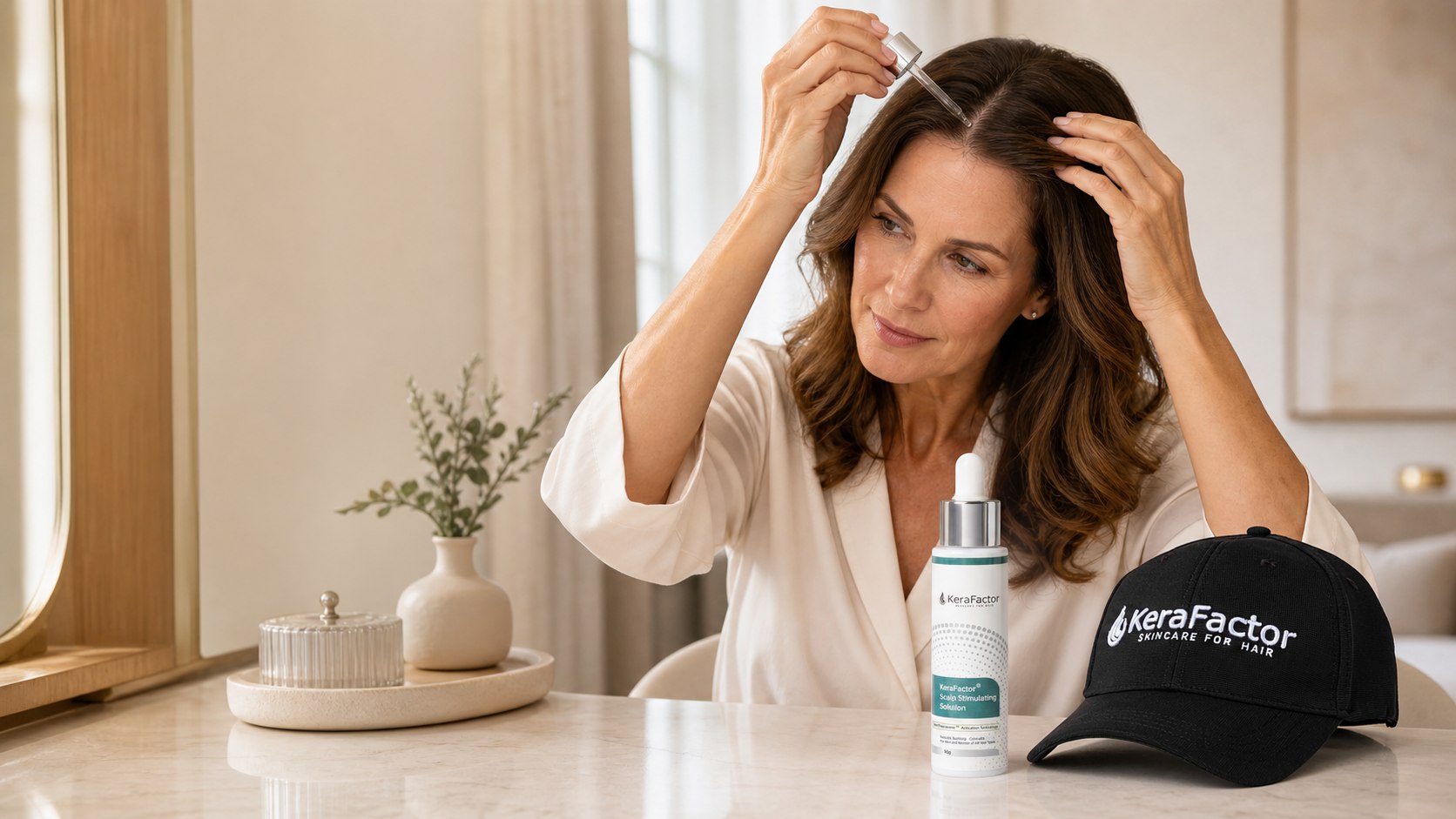
KeraFactor Scalp Stimulating Solution is applied daily with a dropper as cosmetic scalp care. Its synthetic biomimetic growth factors, peptides, and nanofluorosome are wrapped in a delivery technology designed to support the scalp environment and the appearance of fuller, healthier-looking hair.[7]
The KeraFlex Laser Cap is used according to its current instructions. Together, the cap and daily solution create a consistent at-home routine: targeted light exposure from the device and daily cosmetic support from the topical formulation.
The two products are designed to complement one another: the solution provides daily cosmetic scalp support, while the KeraFlex cap delivers 650 nm red light designed to photoactivate the photosensitive curcuminoids within the solution’s nanofluorosome delivery system. This complementary relationship reflects how the KeraFactor system was intentionally designed to be used, advanced topical care paired with a specific light-activation step.
In office: fractional delivery, KeraFactorMD, then KeraFlex
First, an appropriate nonablative fractional laser or microneedling is used to create controlled microchannels that support topical delivery while preserving the surrounding tissue. KeraFactorMD is then applied to the prepared scalp. The treatment finishes with the KeraFlex Laser Cap as the light-activation step.
The sequence matters:
1. Prepare: Nonablative fractional laser or microneedling supports topical access through controlled microchannels.
2. Apply: KeraFactorMD is placed directly onto the prepared scalp.
3. Activate: KeraFlex delivers low-level red-light exposure after application.
4. Continue: The patient maintains the routine at home with daily KeraFactor Scalp Stimulating Solution and the KeraFlex cap according to its instructions.
This professional-to-home pathway is what makes the KeraFactor platform different from selling a laser cap as a standalone purchase. The practice begins the protocol in office, and the patient has a practical routine for continuity at home.
The patent behind KeraFactor’s light-activation strategy
KeraFactor’s light-activation approach is not simply a marketing concept.
U.S. Patent No. 12,303,470, invented by James Bartholomeusz, covers methods involving photosensitive curcuminoids formulated with hair growth factors and/or peptides, fractional topical delivery, and subsequent exposure to defined wavelengths of light.[5]
The patent describes applying the formulation to a targeted intraepidermal area and exposing that area to light sufficient to excite the photosensitive curcuminoids. Its claims include light between 600 and 900 nanometers, fractional topical treatment before application, and nanoliposomal formulations containing photosensitive curcuminoids with growth factors or peptides.[5]
In practical terms, this intellectual property reflects the same design logic behind the KeraFactor protocol: prepare the scalp, apply the formulation, and then use an appropriate light source as the activation step.
How to evaluate any laser-cap routine
Before purchasing a laser cap, identify the exact model and look for its 510(k) number. Terms such as “FDA registered,” “FDA listed,” or “medical grade” do not establish that a device has received 510(k) clearance.[1]
Read the current instructions before use. Confirm the treatment schedule, fit, coverage area, charging requirements, cleaning directions, and eye-safety information. More exposure is not automatically better, so do not increase the frequency beyond the manufacturer’s directions.
Most importantly, make sure the routine fits the reason your hair is changing. A device or cosmetic scalp product cannot diagnose sudden shedding, patchy hair loss, inflammatory scalp disease, or another underlying condition. If you are unsure why your hair is changing, or the change is sudden, patchy, painful, or accompanied by scalp inflammation, we recommend an evaluation by a qualified medical professional.
A smarter way to think about laser caps
The most useful question is not, “Which cap has the most diodes?”
It is, “How does this device fit into a thoughtful, consistent scalp-care plan?”
For KeraFactor, that plan connects professional care with daily home use. The in-office KeraLase protocol combines nonablative fractional delivery, KeraFactorMD, and low-level laser light. At home, KeraFlex is paired with daily KeraFactor Scalp Stimulating Solution to support continuity between professional visits.
The cap is important. The formulation is important. The sequence, and the consistency, are what turn separate steps into a system.
Explore the KeraFlex Laser Cap
Explore KeraFactor Scalp Stimulating Solution
Sources
[1] FDA: Learn if a Medical Device Has Been Cleared for Marketing
[2] FDA 510(k) K252325: Hair Growth Laser Cap
[3] Systematic Review and Meta-Analysis of Home-Use LLLT Devices for Pattern Hair Loss
[4] Low-Level Laser and LED Therapy in Alopecia: Systematic Review and Meta-Analysis
[5] US12303470B2: Method and Composition for Selective Treatment of Androgen Receptors
[6] KeraFactor: KeraFlex Laser Cap
[7] KeraFactor: Scalp Stimulating Solution