

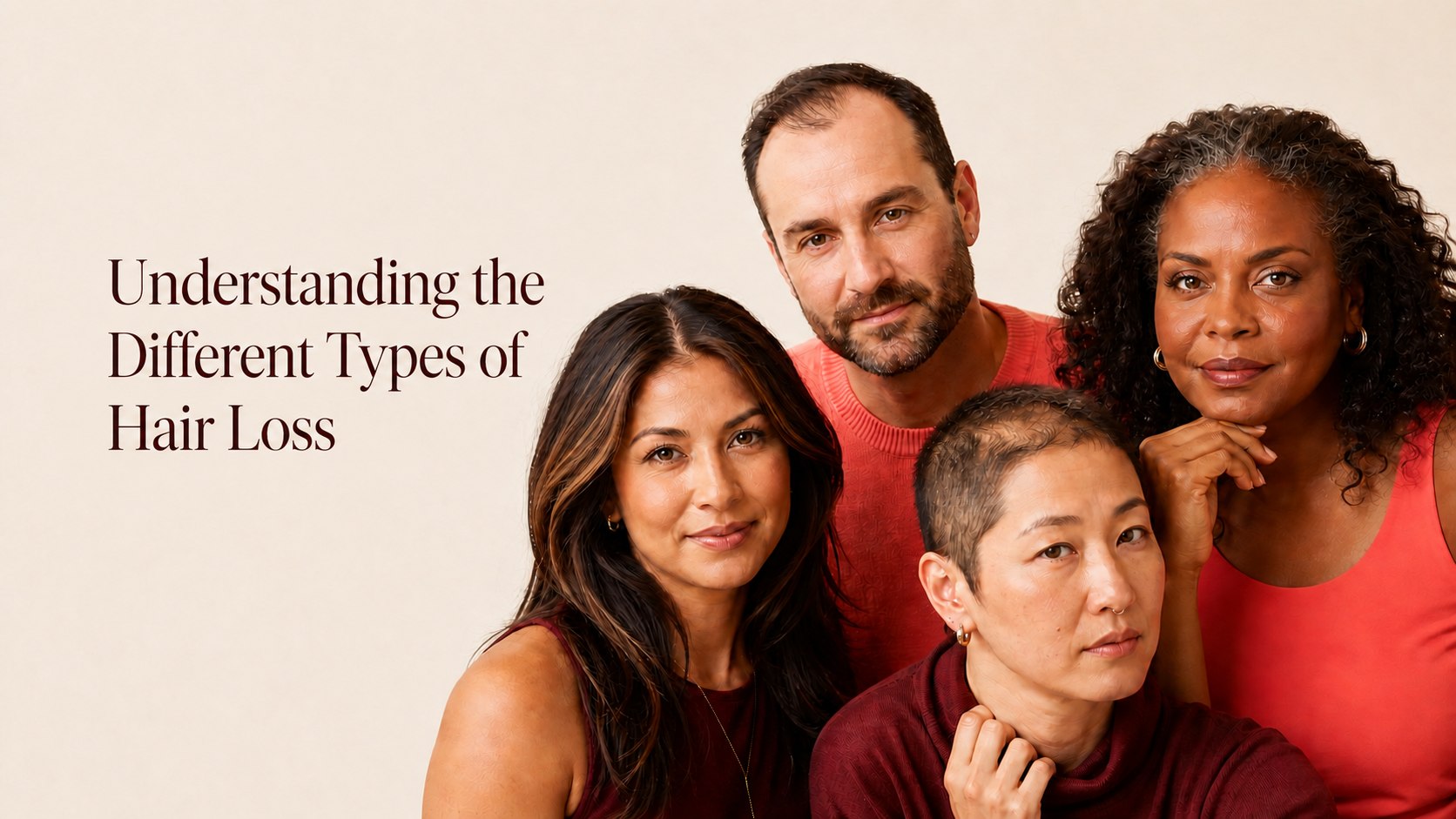
Hair Loss Awareness Month: Understanding the Different Types of Hair Loss
August is Hair Loss Awareness Month, an opportunity to talk honestly about an issue that can affect far more than appearance.
Hair loss can change how people see themselves, how they style their hair, and how confident they feel walking into a room. Yet one of the most important facts about hair loss is often overlooked: not all hair loss is the same.
Thinning at the crown, sudden shedding, a widening part, and a smooth bald patch can point to very different conditions. Understanding the pattern is the first step toward finding the right professional guidance and building a more informed scalp-care routine.
1. Androgenetic alopecia: Gradual pattern hair loss
Androgenetic alopecia, often called male or female-pattern hair loss, is the most common cause of hair loss worldwide.[1] It is influenced by genetics and typically develops gradually
In women, it may appear as:
- A widening part
- Reduced density through the crown
- A thinner-looking ponytail
- More visible scalp under bright light
In men, it often begins with:
- A receding hairline
- Thinning at the temples
- Reduced coverage at the crown
Because the changes can be subtle at first, photographs taken under consistent lighting can be helpful for tracking progression. A dermatologist or qualified hair-restoration professional can determine whether the pattern is consistent with androgenetic alopecia and discuss appropriate options.
2. Telogen effluvium: Excessive, diffuse shedding
Sometimes the concern is not a specific bald area, but a noticeable increase in hair coming out during washing, brushing, or styling. This can be a form of excessive shedding known as telogen effluvium.
Telogen effluvium may follow a significant physical or emotional stressor, such as:
- Illness or high fever
- Surgery
- Childbirth
- Rapid weight loss
- Severe or prolonged stress
- Major nutritional changes
The shedding may not begin immediately. It can become noticeable months after the triggering event, which is why people do not always connect the two.[2]
Telogen effluvium often affects the scalp diffusely rather than creating one clearly defined patch. Although it may improve as the underlying trigger resolves, persistent or severe shedding deserves professional evaluation.
3. Alopecia areata: Sudden, patchy hair loss
Alopecia areata is an autoimmune disease in which the immune system attacks hair follicles. It most often causes circular or oval patches of hair loss on the scalp, but it can also affect the beard, eyebrows, eyelashes, or other areas of the body.[3]
The patches may appear suddenly and feel smooth to the touch. Some people experience one isolated area, while others develop more extensive hair loss.
Alopecia areata is a medical condition, not simply a scalp-care concern. Anyone noticing sudden, clearly defined patches should see a board-certified dermatologist for diagnosis and treatment guidance.
4. Traction alopecia: Hair loss caused by repeated tension
Traction alopecia develops when hairstyles repeatedly pull on the hair and scalp.[1] Tight braids, ponytails, extensions, weaves, buns, or other high-tension styles may place stress on vulnerable areas, particularly around the hairline and temples.
Early warning signs can include:
- Broken hairs around the hairline
- Tenderness after styling
- Small bumps or irritation
- Progressive thinning where the greatest tension occurs
A hairstyle should not consistently hurt. Reducing tension early may help protect the hair before the (2/2) damage becomes more difficult to address.
5. Scarring alopecia: When early diagnosis is critical
Scarring, or cicatricial, alopecia refers to inflammatory conditions that damage and eventually destroy hair follicles.
One example is central centrifugal cicatricial alopecia, or CCCA. It commonly begins near the crown and may gradually spread outward. CCCA is more frequently diagnosed in Black women and can cause permanent hair loss if it progresses untreated.[4]
Symptoms may include:
- Thinning or loss at the center of the scalp
- Itching
- Burning
- Tenderness
- Scaling or inflammation
This is one reason hair loss should never be dismissed as “just cosmetic.” When thinning is accompanied by scalp pain, inflammation, or changes in skin texture, prompt medical evaluation is especially important.
Shedding, breakage, and hair loss are not interchangeable
Hair found in the shower does not always mean the follicle has stopped producing hair. Hair can shed from the root, break along the shaft, or become progressively finer over time.
That distinction matters. More conditioner will not correct an autoimmune condition, and a medical treatment cannot undo a styling habit unless the source of tension is also addressed.
Before choosing a solution, ask:
1. Is the change sudden or gradual?
2. Is it diffuse or concentrated in one area?
3. Is the hair shedding from the root or breaking?
4. Is the scalp itchy, painful, inflamed, or scaly?
5. Did the change follow an illness, pregnancy, medication change, rapid weight loss, or stressful event?
These observations can help a dermatologist or hair-restoration professional understand what may be happening.
Where scalp care fits
The scalp is the environment from which every hair emerges. Keeping it clean, balanced, hydrated, and well cared for is a valuable part of any consistent hair-health routine.
KeraFactor takes a scalp-first approach with professional and at-home systems designed to nourish the scalp and support the appearance of healthier, fuller-looking hair between treatments.[5] Its cosmetic scalp-care products can complement an appropriate professional plan, but they are not substitutes for diagnosing or treating alopecia or another medical condition.
That distinction is central to responsible hair care: support the scalp, understand the cause, and involve the right professional when needed.
Awareness should lead to action
Hair Loss Awareness Month is not about creating fear around every strand in the shower. It is about helping people recognize meaningful changes sooner and understand that hair loss deserves a thoughtful, individualized response.
If you have noticed persistent shedding, widening of your part, patchy loss, scalp discomfort, or a change in density, document what you are seeing and speak with a qualified professional. The earlier you understand the type of hair loss, the sooner you can build a plan that fits your needs.
Sources
[1] American Academy of Dermatology: Hair loss—who gets it and causes
[2] American Academy of Dermatology: Hair loss or shedding?
[3] National Alopecia Areata Foundation: Alopecia areata